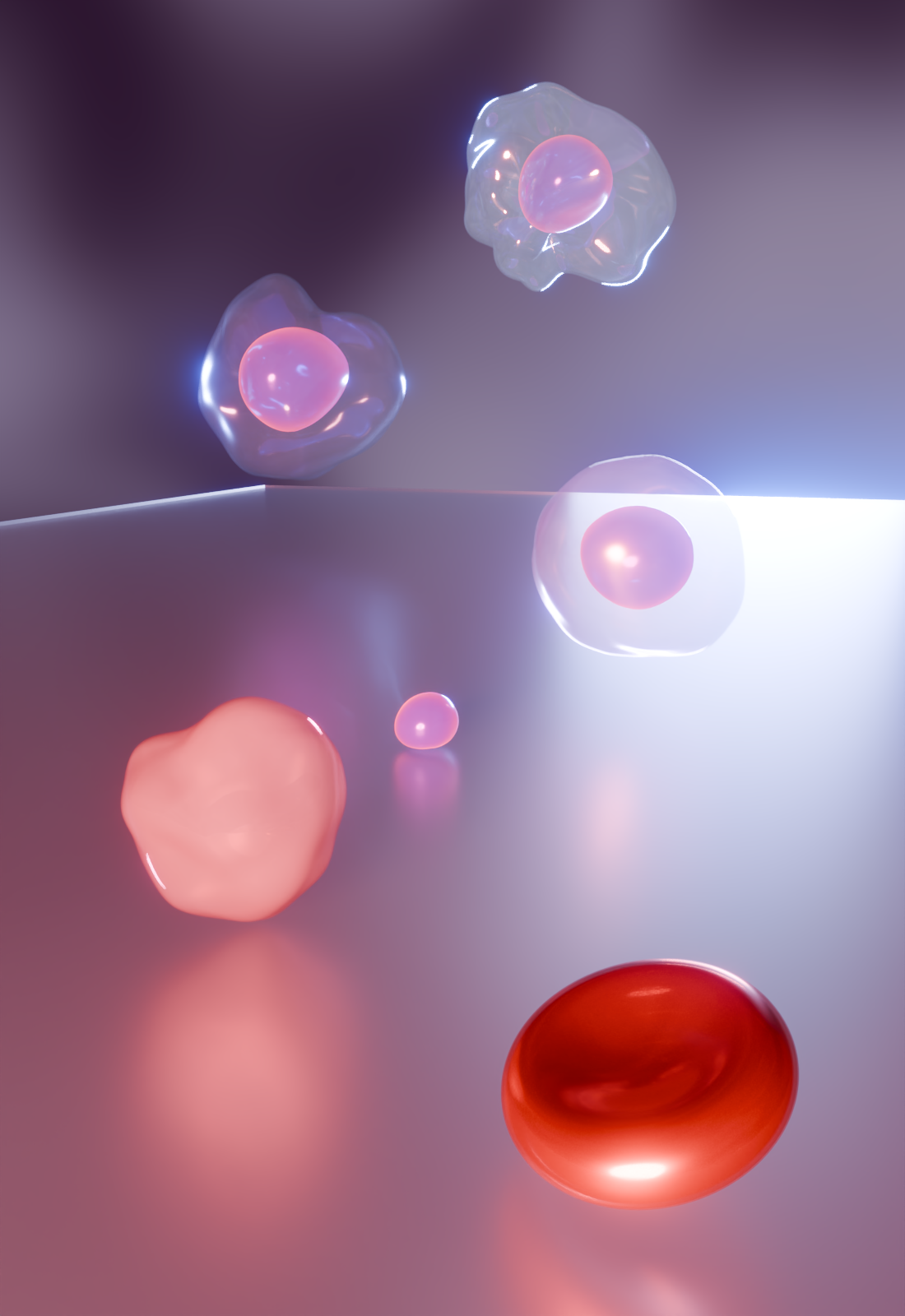
Erythrocyte maturation
An exploration into depth & perspective in conveying cellular maturation.
This image shows 5 cells representing the 5 major stages of erythrocyte development, dropping onto a frosted glass slide. From top to bottom, they are hemocytoblast, proerythroblast, erythroblast, reticulocyte, and erythrocyte. Their proximity to the surface of the glass slide represent lineage commitment and a loss of self proliferative capacity, with the ejected nucleus of the reticulocyte being a pivotal determinant against proliferative capacity.
Mechanism of Catnip
An animated abstract inspired by Uenoyama et al. “The characteristic response of domestic cats to plant iridoids allows them to gain chemical defense against mosquitoes.” Sci. Adv. 2021
This short was inspired by a research article where the researchers found that Nepetalactol (C10 H16 O2), a natural mosquito repellant in catnip and silver vine, also triggers endorphin release in cats and other felines. When cats sense this compound, the mu-opioid receptors in the olfactory centers of their brain get triggered, followed by rubbing and rolling behavior that gets more insect repellant on their face and body, especially the areas around the eyes that have less fur and can be more sensitive to mosquito bites. Researchers think that evolutionarily, this response may help wild felines protect themselves against bug bites while hunting, since felines typically stalk their pray by crouching low to the ground and hiding in tall grasses that are laced with insects.
Clotting Cascade 2D animation
This 2D animation of the clotting cascade was custom built for a learning module, where independent 2D assets can be used to integrate with module software for an interactive learner experience.
“Caitlin was a huge help to me and my research group. She worked with us to create a beautifully detailed video that clearly explains some pretty complex AI modeling… that’s going to be key in helping us share this work more broadly.
We were all pleasantly surprised by just how professional and creative the final product was. That’s entirely thanks to Caitlin’s efforts. Her eye for design, attention to detail, and ability to bring clarity to technical content really made a difference.”
~ Zachary Wooten, PhD., Biostatistics Faculty (St. Jude Children’s Research Hospital)
The full series of biostatistical software animation can be found on St. Jude Research Biostatistical Software page.
A note on process
For well-defined projects with immediate and specific use case, the final product can be delivered within 3 to 4 check-ins, at a rhythm of 2 - 7 days between check-ins, depending on the complexity of each visual build, revision, and the requester’s urgency.
An initial meeting following a partner request generally establishes the aesthetics, scope, and timeline of the project. Once the project has started, I provide partners with progress updates every 2 - 7 business days. This frequency of check-ins ensure we remain on the same page and that partner feedback is incorporated consistently as I build toward the final product.
Time to completion is project specific, and can be anywhere from 2 to 6 weeks from initial request to completion. Rush projects are possible, but may require refining the scope of the project to focus on immediate communication needs. In these cases, I work with partners to find alternative solutions to meet tight deadlines.
To prioritize properly, I am currently not accepting projects that I expect to take more than 2 months to complete.