Animated Abstracts can captivate an audience and create memorability for your work.
Use animations to help your audience understand mechanistic findings and workflows. Animations can support conference presentations and lab webpages to create an elevated viewing experience for prospective collaborators and trainees.
Animating for Conference Presentation at EUROMIT 2026
Using animations to summarize a phenotype or mechanism can be a powerful way to communicate your research to your audience. Dynamic visuals that are aligned and focused to your message helps your audience see and hear your message simultaneously, enabling more rapid understanding and enhancing memorability. An aesthetic visual inspires curiosity as well, encouraging viewers to want to learn more, engage in discussions, which can further enlighten the investigators on which future avenues of research may be the most fruitful to prioritize.
This animation depicting a ballooning mitochondrial morphology resulting from loss of mitochondrial protein MIC60 was made to accompany a flash talk for first author Stephanie Rockfield, PhD at EUROMIT 2026. The animation was created using Blender, and based upon microscopy images and videos provided by Dr. Rockfield.
Conference Animation to tailored to speaker presentation style
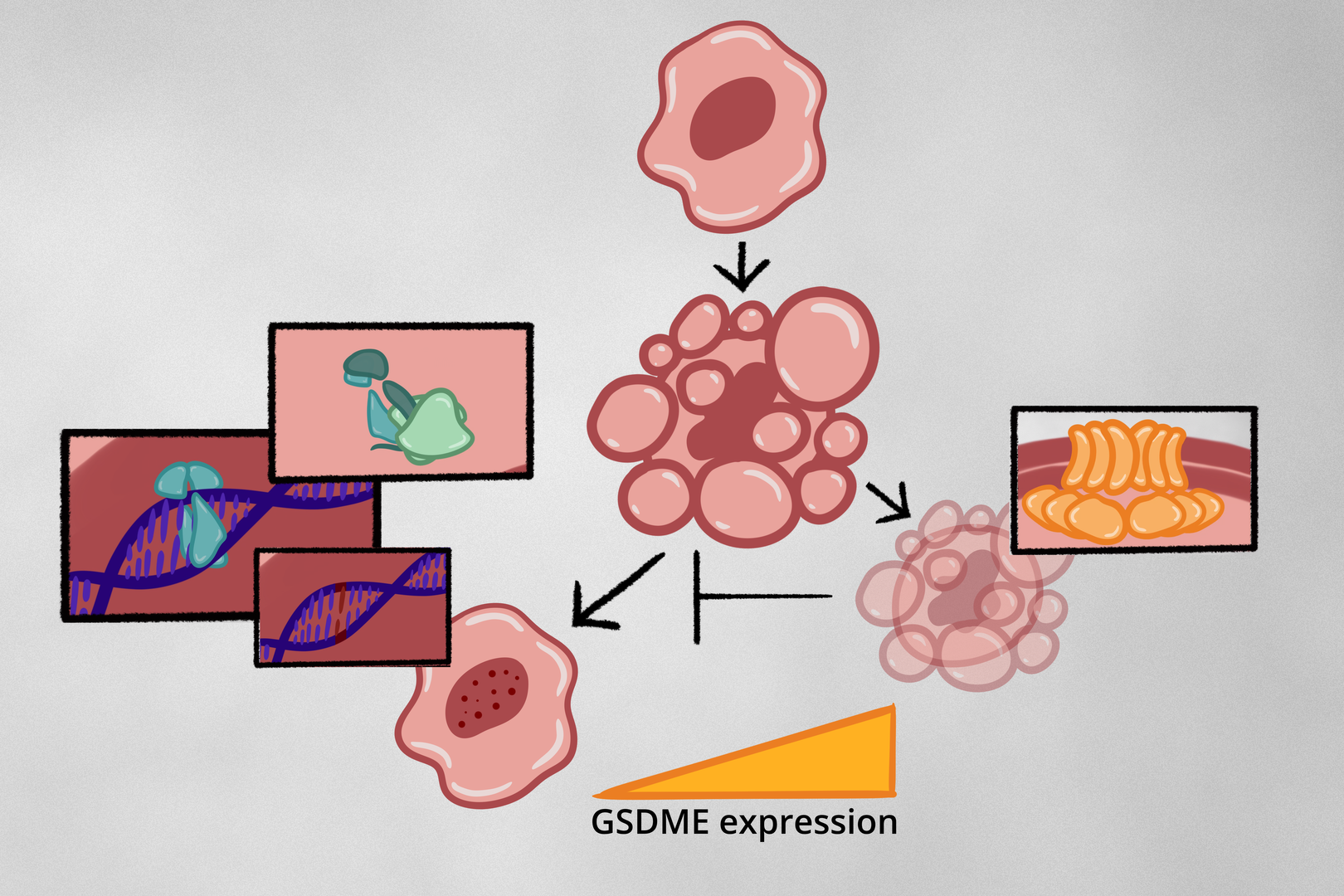
This 2D summary graphic and accompanying quick animations are tailored to the speaking and presentation style of the corresponding author, describing a finding in which pore forming protein GSDME precludes mutational potential from preventing cells from recovering from apoptosis induction.
Liu et al. Tumor gasdermin E acts as a rheostat to limit apoptotic cell survival and mutagenesis in anticancer immune environments.Sci. Adv.12,eaeb1137(2026).DOI:10.1126/sciadv.aeb1137
Animated Mechanism of Catnip
An animated abstract inspired by Uenoyama et al. “The characteristic response of domestic cats to plant iridoids allows them to gain chemical defense against mosquitoes.” Sci. Adv. 2021
This animated abstract was inspired by the research article by Uenoyama et al. where the authors found that Nepetalactol (C10 H16 O2), a natural mosquito repellant in catnip and silver vine, also triggers endorphin release in cats and other felines. When cats sense this compound, the mu-opioid receptors in the olfactory centers of their brain get triggered, followed by rubbing and rolling behavior that gets more insect repellant on their face and body, especially the areas around the eyes that have less fur and can be more sensitive to mosquito bites. Researchers think that evolutionarily, this response may help wild felines protect themselves against bug bites while hunting, since felines typically stalk their pray by crouching low to the ground and hiding in tall grasses that are laced with insects.
Animated Preview for Biostatistics Software - lsBART
location smoothed Bayesian Additive Regression Trees
This motion-graphics based summary describes lsBART - a biostatistical software developed by St. Jude faculty Zachary Wooten, Ph.D., used for AI-assisted medical imaging analysis.
Zachary T Wooten et al. Location smoothed Bayesian additive regression trees: a method for interpretable and robust quality assurance of organ contours in radiotherapy treatment planning, Journal of the Royal Statistical Society Series C: Applied Statistics, Volume 74, Issue 5, December 2025, Pages 1301–1320, https://doi.org/10.1093/jrsssc/qlaf024
This animation, along with a series of 7 other biostatistical animated previews were built to enable easier understanding of recently developed biostatistical software at St. Jude’s Children’s research hospital, and can be found on both the individual faculty research pages and the departmental software resource page.
Primer to Epigenetics - adding animation to hand gestures from existing interviews
Every researcher I’ve ever spoken to have gestured with their hands while explaining their findings.
People use gestures to visually represent what they picture in their mind while talking. Unfortunately, unless you’re already familiar with the subject matter and can conjure up those images as the speaker is explaining and gesturing, the gestures become ineffective - so let’s fix that!
Adding simple and unambiguous animations to off-the-cuff scientific explanations not only save time and budget for video production pipelines, but also help both the expert in delivering the message, and your audience in receiving it. Furthermore, unscripted explanations inherently bring a level of authenticity that modern viewers gravitate to. A scientific animator who understands the science and can empathize with both the speaker on what they want to convey, and the audience for how they want to learn, is key to bringing a high scientific content piece alive.
This clip originates from an interview from Modern Wisdom. While Mr. Epstein is not an epigenetics researcher, his explanation of epigenetic mechanism is appropriate for the Modern Wisdom audience - intelligent viewers who do not necessarily possess biology backgrounds. Visuals I created to sync to his speech and gestures help lend another level of clarity on biological mechanisms, helping audiences better comprehend scientific jargon such as “switches”, gene “openness”, the connection between DNA, RNA, and proteins, etc.
Animated Preview for Biostatistics Software - MOADE
MultimOdAl Dissociation via AutoEncoder for deconvolution of bulk multi-omics data
This motion-graphics based summary describes MOADE - a biostatistical software developed by St. Jude faculty Qian Li, Ph.D., for deconvolution and cross-analysis of multi-omics data.
Sun et al. MOADE: a multimodal autoencoder for dissociating bulk multi-omics data. Genome Biology. 2025. https://doi.org/10.1186/s13059-025-03805-1
This animation, along with a series of 7 other biostatistical animated previews were built to enable easier understanding of recently developed biostatistical software at St. Jude’s Children’s research hospital, and can be found on both the individual faculty research pages and the departmental software resource page.
The Cell at Cytokinesis
Cytokinesis, the last stage of cell division, is frequently depicted as simply the pinching away of two cell bodies. However, cytokinesis is the result of active contraction by the microtubule midbody ring, whose driving contribution is often not depicted and hence easily overlooked in the collective imagery of mitosis and meiosis. In my practices, I intentionally focus on re-excavating foundational aspects of cellular and molecular biology whose visualization cannot be easily found, to continually hone scientific, creative, and technical acumen in bringing the invisible to light.
A note on process
For well-defined projects with immediate and specific use case, the final product can be delivered within 3 to 4 check-ins, at a rhythm of 2 - 5 days between check-ins, depending on the complexity of each visual build, revision, and the requester’s urgency.
An initial meeting following a client request generally establishes the aesthetics, scope, and timeline of the project. Once the project has started, I provide clients with progress updates every 2 - 5 business days. This frequency of check-ins ensure we remain on the same page and that client feedback is incorporated consistently as I build toward the final product.
Time to completion is project specific, and can be anywhere from 2 to 6 weeks from initial request to completion. Rush projects are possible, but may require refining the scope of the project to focus on immediate communication needs. In these cases, I work with clients to find alternative solutions to meet tight deadlines.
Let’s work together ~
To work with me, simply email Beiyun@cliubioanimation.studio with the following information:
Your name, email contact, and timezone
Brief project description
Relevant supporting material to help me better understand your vision - these can be project drafts, research papers, sample visuals, etc.
I generally respond within 2 business days with follow-up questions and to set up a virtual meeting to discuss project details.
My timezone is GMT-6.
Looking forward to connecting!